

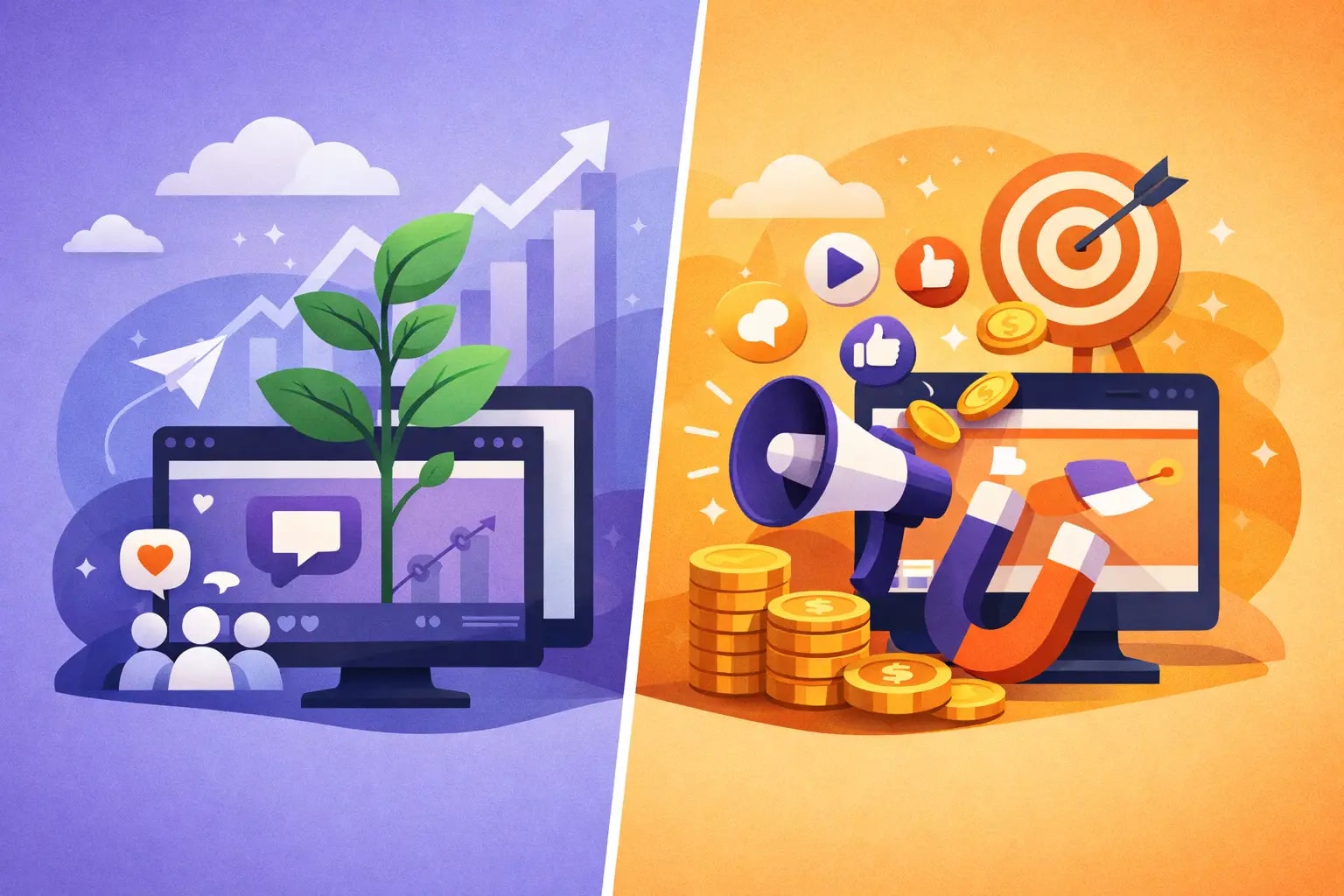
Organic Twitch Growth Versus Paid Promotion
A stream with five real regulars can be more valuable than a stream with 50 people who never return. That is the real question behind organic Twitch growth versus paid promotion: are you building attention that compounds, or buying attention that disappears when the campaign ends?
For creators chasing Affiliate goals, sponsorship leverage, and stronger browse-page momentum, both organic work and paid distribution can have a place. But they do different jobs. Treating them as interchangeable is how streamers burn budget, lose focus, and mistake a temporary spike for channel growth.
What Organic Twitch Growth Actually Builds
Organic growth is earned attention. A viewer finds a clip, sees a recommendation, joins a raid, hears about you from another creator, or returns because last stream was genuinely fun. They choose to follow, chat, and come back without being pushed there by a campaign.
That process is slower than most creators want. It is also where the strongest signals come from: returning viewers, average watch time, chat participation, community habits, and viewers who recognize each other. These are the people who make a quiet stream feel active before the stream even takes off.
Organic growth works best when your content has a clear reason to exist. “I play games” is not a positioning strategy. “I speedrun horror games with chat-controlled punishments,” “I break down ranked matches for new players,” or “I host late-night IRL city walks with local food challenges” gives viewers a reason to remember you.
Consistency matters, but not in the empty “stream every day” sense. A reliable schedule helps only when your format is recognizable and your stream has moments worth sharing. Three focused broadcasts with a strong hook, clean title, active chat prompts, and clips built into the show can outperform seven unfocused streams.
The Organic Metrics Worth Watching
Follower count gets attention, but it is rarely the best indicator of channel health. Watch your average concurrent viewers, returning viewers, chatters per stream, follows per unique viewer, and clip performance. Together, these show whether people are simply passing through or becoming part of your audience.
A creator with fewer followers but a high return rate is in a strong position. They have evidence that the channel delivers. That makes every future stream, collaboration, and promotion more likely to produce results.
When Paid Promotion Makes Sense
Paid promotion is not automatically a shortcut, and it is not automatically bad. Used correctly, it is distribution. You pay to put a real piece of content in front of people who may actually care about it.
The best paid campaigns amplify something that already works. If a short clip earned strong watch time and comments organically, putting ad spend behind it can introduce your channel to more viewers with similar interests. The same applies to sponsored placements with relevant creators, paid newsletter features, event partnerships, and targeted social campaigns.
What paid promotion cannot do is create a compelling stream format for you. It cannot fix weak audio, a blank stream title, dead air, or a channel that gives new viewers no reason to stay. Paid reach magnifies the experience you already have - good or bad.
For a newer streamer, a small test budget can be smarter than a large launch. Run one campaign around a specific clip or event, set a clear spending cap, and measure the outcome after the traffic has had time to settle. Did viewers visit the channel? Did they follow? More importantly, did they return for another live stream?
If the answer is no, the campaign may have reached the wrong audience, the creative may have overpromised, or the live experience may need work. That is useful information. Throwing more money at the same setup is not.
Organic Twitch Growth Versus Paid Promotion: The Real Trade-Off
Organic growth costs time, creative energy, and patience. Paid promotion costs money, requires testing, and can create misleading results if you focus only on impressions or follower spikes.
Organic growth is usually stronger for retention and community trust. Paid promotion is usually stronger for speed and controlled reach. The winning approach for many serious streamers is not choosing one forever. It is using organic content to prove what resonates, then using legitimate paid distribution to scale the best-performing ideas.
Think of organic work as product development. You test games, segments, stream times, thumbnails, clip styles, and opening hooks until you learn what viewers respond to. Paid promotion comes after that, when you have a message worth putting in front of more people.
This is especially relevant in competitive categories like Just Chatting, GTA RP, Valorant, Fortnite, and IRL. Browse pages move fast. A clear format and memorable content can earn discovery, but a targeted campaign can help a strong moment reach beyond your existing follower base.
The Cost Question: Budget for Learning, Not Vanity
A paid campaign should have a job. Maybe you want to fill a charity stream, drive viewers to a tournament broadcast, promote a new series, or introduce a proven clip format to a new audience. Define the job before you spend.
Avoid judging performance by raw views alone. Cheap impressions can look impressive while producing no meaningful channel activity. A better question is: what did each dollar produce in terms of qualified viewers, returning viewers, email signups if you use them, Discord joins, or live participation?
You also need to account for time. Organic content is not free when it takes ten hours to edit one clip. If a paid campaign helps a high-quality clip reach the right people quickly, that may be a smart use of budget. If you are paying to promote generic content with no hook, it is probably not.
What Not to Buy
Do not confuse compliant promotion with artificial engagement. Paying for fake viewers, fake chat activity, fake follows, or manipulated stream metrics is a high-risk move. It can violate platform rules, damage trust with real viewers, distort your analytics, and put monetization or account standing at risk.
It also creates bad decision-making. If your dashboard shows inflated activity, you cannot accurately tell which games, segments, or clips are actually attracting people. You may keep producing content based on signals that were never real.
Real growth needs real people on the other side of the screen. If you are spending money, spend it on legitimate advertising, creative production, creator collaborations, event promotion, or tools that improve your actual broadcast quality and workflow.
Build a Growth Mix That Fits Your Stage
If you are under 10 average viewers, prioritize format clarity and repeat viewers. Make the first ten minutes of every stream worth joining. Greet people quickly, explain what is happening, set up a challenge, and give chat an easy way to participate. Use clips to create a trail back to your live channel.
If you are averaging 10 to 50 viewers, start collaborating with adjacent creators and experiment with small paid tests around your best clips or biggest streams. At this stage, your goal is not maximum reach. It is finding audience overlap that converts into returning viewers.
If you are already established, paid promotion can support launches, events, sponsor deliverables, and new content categories. Keep protecting the community that got you there. A sudden audience increase means nothing if your core viewers feel ignored or the stream loses its identity.
No matter your size, keep one simple loop running: stream, identify the strongest moment, turn it into short-form content, measure the response, and improve the next broadcast. That loop is less glamorous than chasing a big metric spike, but it is how channels become durable.
The best investment is the one that gives a real viewer a clear reason to click, stay, and come back next week. Build that reason first, then put your promotional budget behind it.